



Power Scrubbing Parkades: 6 Things Every Property Manager Should Know
Power scrubbing gets left off a lot of maintenance budgets until a tenant complains about the smell, or someone slips near the elevator vestibule and now there’s an incident report to file. If you manage a commercial or mixed-use building with an underground or covered parkade, this is one of those line items that’s easy to underestimate. A parking level takes a beating every single day, oil drips, brake dust, road salt, tire rubber, and none of that comes off with a broom or a garden hose.
Here’s what we’ll cover:
- What power scrubbing actually does
- Why parkades need more than a hose down
- The environmental side property managers can’t ignore
- How often to schedule it
- What to look for in a contractor
What Power Scrubbing Actually Does
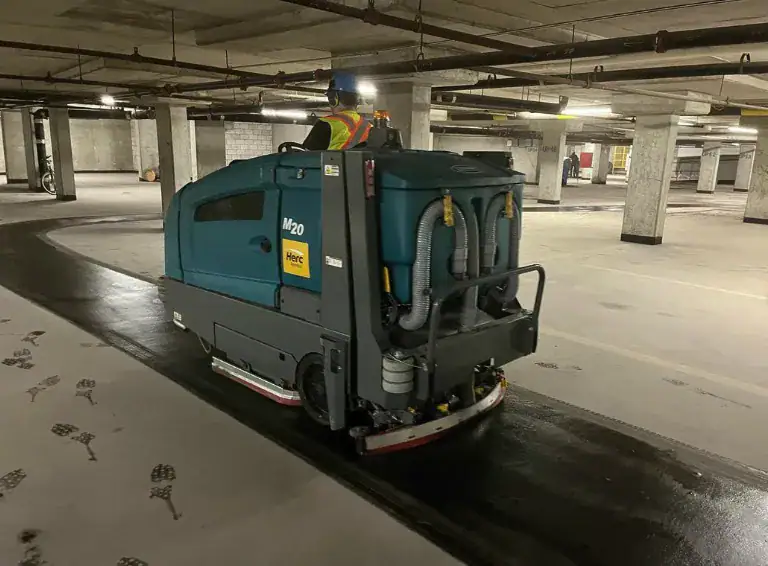
Power scrubbing uses a rotating brush head, usually mounted on a ride-on machine, combined with pressurized water and a cleaning solution to break down and lift ground-in grime. It’s a different job than power washing, which is more about rinsing loose dirt and algae off a surface, or power sweeping, which clears dry debris. On a parkade floor, the brush action matters, because oil and tire residue bond to concrete in a way that plain water pressure won’t touch.
For most buildings, the parkade gets power scrubbing while the exterior and walkways get power washing on a separate schedule. They’re related services, but they’re not interchangeable, and a contractor who only offers one usually isn’t the right fit for a full-building maintenance plan.
Why Parkades Need More Than a Hose Down
A parkade is a closed, low-airflow environment, so oil and grease buildup doesn’t just look bad, it holds odor. Over time it also degrades sealants and coatings on the concrete, which shortens the life of the surface and adds to your capital repair costs down the road. There’s a safety piece too. Oil film on a ramp or a stall gets slippery fast, and it’s exactly the kind of hazard that ends up in a liability claim if it’s not addressed on a regular basis.
Property managers dealing with tenant turnover, especially in mixed residential and commercial buildings, also know that a clean parkade is one of the first things prospective tenants notice on a walkthrough. It’s not just maintenance, it’s part of how the building presents itself.
The Environmental Side Property Managers Can’t Ignore
This is the part that catches a lot of buildings off guard. Wash water from a parkade cleaning job isn’t supposed to just run down the nearest floor drain into the storm system. Vancouver’s Sewer and Watercourse By-law sets standards for what can and can’t be discharged, and parkade wash water loaded with oil, grease, and sediment is exactly the kind of runoff municipalities are trying to keep out of the storm system.
A qualified contractor should be capturing and properly disposing of wastewater, not just hosing everything toward the nearest drain. If you’re evaluating vendors, this is worth asking about directly. It’s a compliance issue for the building, not just an operational preference.
What It Costs When You Put It Off
Deferred parkade maintenance tends to show up as a bigger line item later. Oil and grease that sits for months can stain concrete permanently, which means the fix moves from a cleaning job to a resurfacing or sealant reapplication job, at a much higher cost. Insurance is another factor. If a slip-and-fall claim ever gets reviewed, a documented cleaning schedule is one of the first things an adjuster or lawyer will ask for. Not having one puts the building, and by extension the property manager, in a weaker position.
None of this means power scrubbing needs to be expensive or complicated. It just needs to be consistent, and it needs to be documented, so it’s working for the building instead of just being a recurring invoice nobody can account for.
How Often Should You Schedule Power Scrubbing?
It depends on the size of the parkade, how many stalls are in use, and whether the building sees heavy turnover of vehicles. As a general guide:
- Underground parkades with regular vehicle traffic: quarterly
- High-turnover commercial or retail parkades: every one to two months
- Smaller stratas with light usage: twice a year
Buildings near the coast or in areas that see winter road salt should lean toward more frequent scrubbing, since salt accelerates concrete deterioration and tracks in faster than most people expect.
What to Look for in a Power Scrubbing Contractor
Not every janitorial company offers real parkade scrubbing equipment. Look for a contractor who can show you their machine, explain their wastewater handling process, and give you a documented schedule rather than a vague promise to “come by when needed.” Photo reporting after each visit is a good sign too, since it gives property managers something concrete to share with owners or clients.
At EcoPlanet Property Services, parkade care is one of our core services across Greater Vancouver, and every job includes proper wastewater handling and photo documentation through our reporting app. You can see more on our parkade cleaning services page, or reach out for a free quote for your building.
To get started, you can visit the janitorial and strata services pages on EcoPlanet.ca or reach out directly in the way that suits you best.
Call 604-565-5238, email team@ecoplanet.ca, or use the contact form at https://ecoplanet.ca/contact-us/ to request a quote or a tailored janitorial services proposal for your Metro Vancouver property. A brief conversation now can set your building up for a cleaner, easier to manage year ahead.