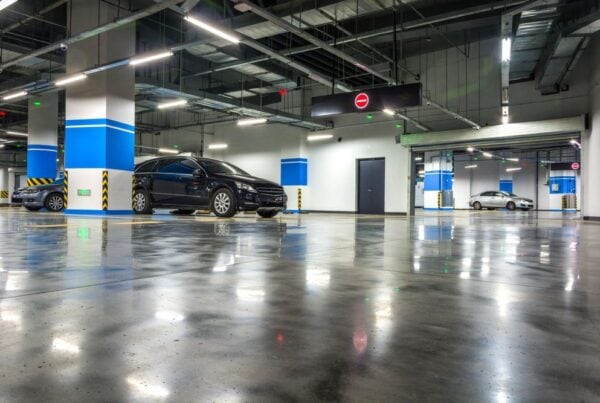


Road salt does its job well. It melts ice and keeps people from slipping, which is exactly why it’s everywhere in a Metro Vancouver winter. The problem is that once it’s done melting ice, it doesn’t just disappear. It gets tracked in on tires and boots, and it settles into the parkade concrete and lobby flooring, where it keeps working long after the ice is gone.
What Salt Actually Does to Concrete
Salt accelerates the freeze-thaw cycle inside concrete. Water carrying dissolved salt seeps into small cracks and pores in the concrete, and as temperatures fluctuate, that water expands and contracts more aggressively than plain water would. Over repeated winters, this process, called scaling or spalling, causes the surface layer of concrete to flake, crack, and deteriorate. Parkades are especially vulnerable because vehicles track in salt continuously through the season, concentrating it in drive aisles and near entrances.
Reinforced concrete faces an additional risk: chloride from salt can eventually reach the steel rebar inside the concrete and cause it to corrode, which is a much more expensive structural problem than surface scaling alone.
What Salt Does to Lobby Flooring
Lobby floors don’t face the same structural risk as parkade concrete, but salt residue still causes real damage. It can dull and etch certain finishes, particularly natural stone and some sealed hard surfaces, and repeated exposure without cleaning accelerates wear on whatever protective coating is in place. Salt-laden water that sits and dries repeatedly leaves behind a white, chalky residue that’s difficult to fully remove once it’s built up over a season.
How to Limit the Damage
- Sweep and clean parkade drive aisles regularly through winter, rather than waiting until spring to address salt buildup. See our guide to year-round parkade cleaning.
- Increase lobby floor cleaning frequency during salted months. Daily or near-daily damp mopping removes residue before it has a chance to sit and dry repeatedly. Our guide to lobby floor maintenance covers a realistic routine.
- Use entrance matting to capture salt before it reaches flooring. Mats need to be rotated and cleaned regularly once saturated, or they stop doing their job.
- Consider a pet-safer or lower-chloride de-icing product in areas where reducing salt load is a priority. We compare the options in our guide to de-icing alternatives.
- Schedule a proper spring power wash to clear the salt, sand, and gravel that accumulated over the whole season before it’s had a chance to sit for months. See our guide to spring cleanup after winter.
Why This Belongs on Your Council’s Radar
Concrete deterioration from years of untreated salt exposure eventually shows up as a line item in your building’s depreciation report, and it’s a far more expensive fix than the cleaning that would have prevented it. A parkade resurfacing project runs into the tens of thousands of dollars; a consistent winter cleaning schedule runs a fraction of that annually. This is a case where prevention is a straightforward budget decision, not a debate.
EcoPlanet Property Services adjusts our cleaning schedules for Greater Vancouver strata and commercial buildings through the winter months specifically to manage salt buildup before it becomes a structural concern. Get in touch to talk about a winter cleaning plan for your parkade and lobby, or explore our parkade scrubbing services.
Winter Salt Damage: Protecting Parkades and Lobby Floors
winter-salt-damage-parkades-lobbies
Road salt tracked into parkades and lobbies corrodes concrete and dulls flooring. Here’s how strata councils can limit the damage each winter.
salt damage parkade, parkade concrete damage, winter floor care, salt corrosion